Writing a brand-creator brief that doesn't waste anyone's time
How to write a creator brief tight enough to get on-brand content on the first pass, without micromanaging the creator out of their best instincts. With the one-page template I send founders.
If you’ve ever shipped a creator a 14-page Notion doc and gotten back a video that hit none of your three actual priorities, you already know the problem. Briefs are where most brand-creator deals quietly go wrong, usually weeks before the content goes live, usually invisible until the draft comes back wrong.
I read a lot of briefs. The ones small brands send tend to fail in one of two directions: too vague (“just be authentic and have fun with it!”) or too prescriptive (a shot list, a script, a list of words you must say, and a list of words you must not). Both produce flat content. The first because the creator has no idea what success looks like. The second because you hired a creator and then asked them to be an actor reading your lines.
A good brief gives the creator a sharp target and then gets out of the way. Here’s the structure I’ve watched work, for one-off deals all the way up to multi-month brand ambassadorships. The full one-page template is downloadable at the end; it’s the exact one I send founders.
1. Lead with the one thing that has to be true
Every brief should open with one sentence: what does this post have to make the viewer believe? Not “drive sales.” Not “raise awareness.” A specific belief in the viewer’s head when the video ends.
For a skincare brand it might be:
“This serum is the one thing I’d keep if I had to cut my routine to three products.”
For a B2B tool:
“I stopped dreading Monday morning because of this.”
For a snack brand:
“This is what I actually keep in my desk drawer.”
If you can’t write that sentence in one line, you’re not ready to brief a creator, you’re ready to do another round of positioning work. Don’t pay a creator $1,500 to figure out your messaging for you. They will guess. They will guess wrong about half the time. Then you’ll blame the creator for a positioning problem that was always yours.
The “one thing that has to be true” is the north star the creator will instinctively pull every creative decision toward. Without it, every scene is a coin flip. With it, the creator can deviate from your literal suggestions and still hit the brief, which is what you actually want, because their instincts about their audience are better than yours.
2. Define the deliverable in shape, length, and platform-native format
This is the section where most briefs get sloppy. “One Reel” is not a deliverable.
“One 30-to-60-second Instagram Reel, vertical 9:16, hook in the first 1.5 seconds, on-screen captions, no copyrighted trending audio because we’re whitelisting”, that’s a deliverable.
Spell out:
- Length window, not a single number. “45–75 seconds” gives the creator room to land the joke or breathe between beats. “60 seconds exactly” makes everyone tense and the content reads tense too.
- Aspect ratio and platform. A TikTok-native Reel reads as a re-upload and underperforms. If you want it to live on both, brief for the more constrained platform and pay for both posts.
- Captions and text overlay, yes or no, and in what style. Captions are non-negotiable for accessibility and silent-feed viewing; don’t leave it up to chance. ~85% of feed views happen on mute.
- Audio rights. Creators using copyrighted trending audio is fine for an organic post and a disaster for whitelisting. Decide upfront and tell them. This single line, missed in the brief, is the most expensive re-shoot trigger I see, because the post performs organically and then you can’t legally boost it.
- Stories + Highlight, separately. If you want Stories with a link sticker, brief them as their own deliverable, not as a vague “and post some Stories too.”
Get this section right and you avoid roughly 80% of re-shoots.
3. Hand over three “anti-examples,” not just examples
Every brand brief includes “here are creators we love.” Almost none include “here is what we explicitly don’t want, and why.” The second list is the more useful one.
The three anti-examples I include in almost every brief:
- One competitor post that looks good on the surface but feels off-brand, with a one-line note on why, “too aggressive on the price call-out, makes the product feel cheap.”
- One past creator deal of your own that underperformed, with the actual numbers and a one-line root cause, “hook landed but the CTA was scripted, conversion flat at 0.3%.”
- One generic UGC template you’re tired of seeing, the “POV: you finally found a [product]” hook, the “things in my bag” trope, whatever your niche has worn out.
Anti-examples are the cheapest way to communicate taste. They also give the creator permission to push back if your positive examples contradict your anti-examples, which they often will, because taste is hard to articulate in the positive direction and almost easy in the negative.
A creator who reads your anti-examples and replies “got it, I was actually going to suggest the POV hook, let me come back with a different angle” has just saved you a re-shoot before any filming happened. Worth the 15 minutes it takes to write three anti-examples.
4. Specify the conversion mechanism, but never the script around it
This is the boundary most brand-creator briefs get wrong. The conversion mechanism is the part the brand owns: the discount code, the link, the landing page, the offer. The script around it is the part the creator owns. Confusing the two is where deals go ugly.
Give the creator:
- The exact code, link, and offer (e.g., “DORCAS25 for 25% off your first month, lands on /micro”).
- The placement window for the CTA, “somewhere in the back half, not as the closing line.”
- Tracking expectations, “we’ll attribute via the code and the UTM, you don’t need to ask viewers to mention you in checkout.”
Do not give the creator:
- A verbatim script for the CTA.
- A mandatory phrase like:
“Use code DORCAS25 at checkout for 25% off your first month, link in bio, available for a limited time only.”
That last sentence is what every script-locked CTA reads like, and the viewer tunes out at the comma. Let the creator write it in their own voice. They know their audience’s tolerance for sales language better than you do. The creator who tells their audience “I worked out a code with the brand if you wanna try it, DORCAS25, it’ll get you 25 off” converts at roughly 2× the rate of the same creator reading your script.
5. Set the disclosure requirement explicitly and in writing
This is the single line founders most often leave out, and it’s the one that can get you into the most trouble. The post must be disclosed as a paid partnership, full stop, every platform, no exceptions. The brief should say so in one unambiguous sentence:
“This is a paid partnership. Please use the platform’s branded-content tool AND include #ad clearly in the caption (first 1–2 lines, not buried in hashtags). We confirm disclosure before payout.”
Two things this does. First, it protects you from FTC issues, which are now actively enforced against the brand, not just the creator. A $50,000 fine for a sloppy disclosure on a $1,500 deal is the kind of math that ends small brands. Second, it sets expectations so the creator doesn’t try to “soft-disclose” with a vague “thanks to [brand] for the gift” line, which doesn’t meet the rules and which, frankly, performs worse than honest disclosure anyway. Audiences in 2026 expect creators to be paid. They reward honesty.
The clause in your contract that mirrors this brief language, “Brand will not release final payment until disclosure is confirmed”, is what actually changes creator behavior. See what to put in a creator contract (and what to leave out) for the exact language.
6. End with the approval loop, the deadline, and the kill switch
The last section of the brief should answer three operational questions in plain language:
- Approval loop. “We’ll review one draft within 48 hours and give you up to one round of feedback. Feedback is scoped to the deliverable spec above. Anything past that is at our discretion to wave or to invoke the change window in the contract.”
- Deadline. A single calendar date, in the creator’s time zone, with the publish-window time-of-day attached. “Post live by Thursday June 12, between 6–9pm ET.” Not “early-to-mid June.” Not “the second week-ish of June.” A date and a window.
- Kill switch. What happens if you both decide the content isn’t working. “If we mutually agree at the draft stage that the angle isn’t landing, we cover a 30% kill fee, you keep the unaired content for your portfolio (no public sharing), and we part ways cleanly.”
The kill switch is the part nobody puts in writing and everyone wishes they had. Spell it out before you need it. The creators worth working with will respect you more, not less, for being a brand that has thought through the unhappy path. In five years of running these deals I have never had a creator push back on a kill switch, and I have had at least a dozen creators sign faster because it was there.
What a tight brief actually looks like
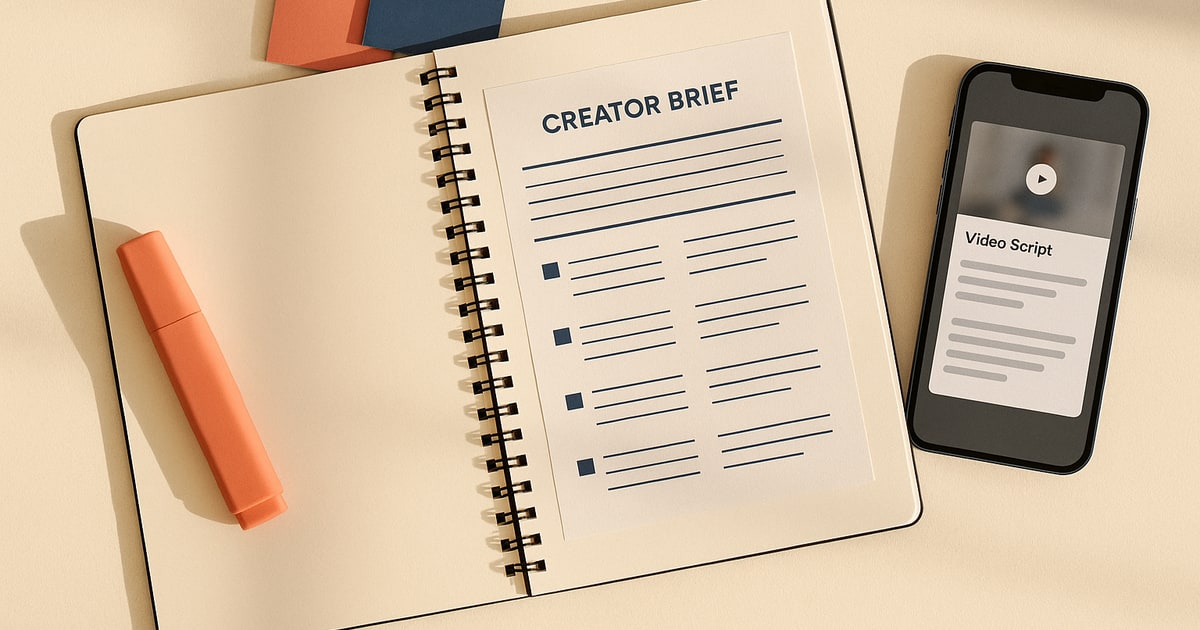
The version I send founders is one page in Google Docs, structured like this:
- The one thing that has to be true (1 sentence)
- Deliverable spec (5 bullets)
- Examples (2 links) and anti-examples (3 links with one-line notes)
- Conversion mechanism (code, link, placement window)
- Disclosure requirement (1 sentence, verbatim from above)
- Approval loop, deadline, kill switch (3 bullets)
That’s it. If your brief is longer than two pages, you are almost certainly substituting word count for clarity. The creator will skim it, miss the important parts, and produce something average. Shorter brief, sharper target, better content.
The two-question pre-send check
Before you hit send on a brief, ask yourself two questions:
- Could a competent creator, reading this brief cold, produce a draft that hits “the one thing that has to be true”? If you’re not sure, the brief is too vague. Tighten the north-star sentence.
- Is there any line in here that tells the creator how to do their job, instead of what needs to be true at the end? If yes, delete that line. You’re micromanaging the creator out of their best instincts.
Those two questions catch most brief failures. Run them every time. They take 30 seconds.
If you remember three things
- Open with the one sentence the viewer has to believe. Everything else in the brief serves it.
- Brief the deliverable in platform-native specifics, and brief the audio rights, that’s the line most missed and most expensive.
- Anti-examples > examples. Three anti-examples with one-line root causes beat ten “creators we love” links.
If you want the template I send founders, plus the contract and proof-of-delivery flow that pair with it, join the CollabBook beta and we’ll send you the working copy we use with our own brand customers. Either way: write the one-sentence belief first, then write the rest of the brief around it, and you’ll cut your re-shoot rate roughly in half.
— Dorcas Faleti, CollabBook